


August 2026 Postscript: How the 2025 Trend Played Out
Updated August 5, 2026. Looking back from mid-2026, the upturn that started in late 2025 went much further than most forecasts allowed: NAND contract prices climbed over 100% in the first half of 2026 before the pace finally moderated to a projected 10–15% for Q3. The drivers stayed the same — AI-server demand absorbing supply while consumer segments weakened. For the current picture, read our 2026 price trend analysis and when prices may drop. (Source: TrendForce, July 2026)
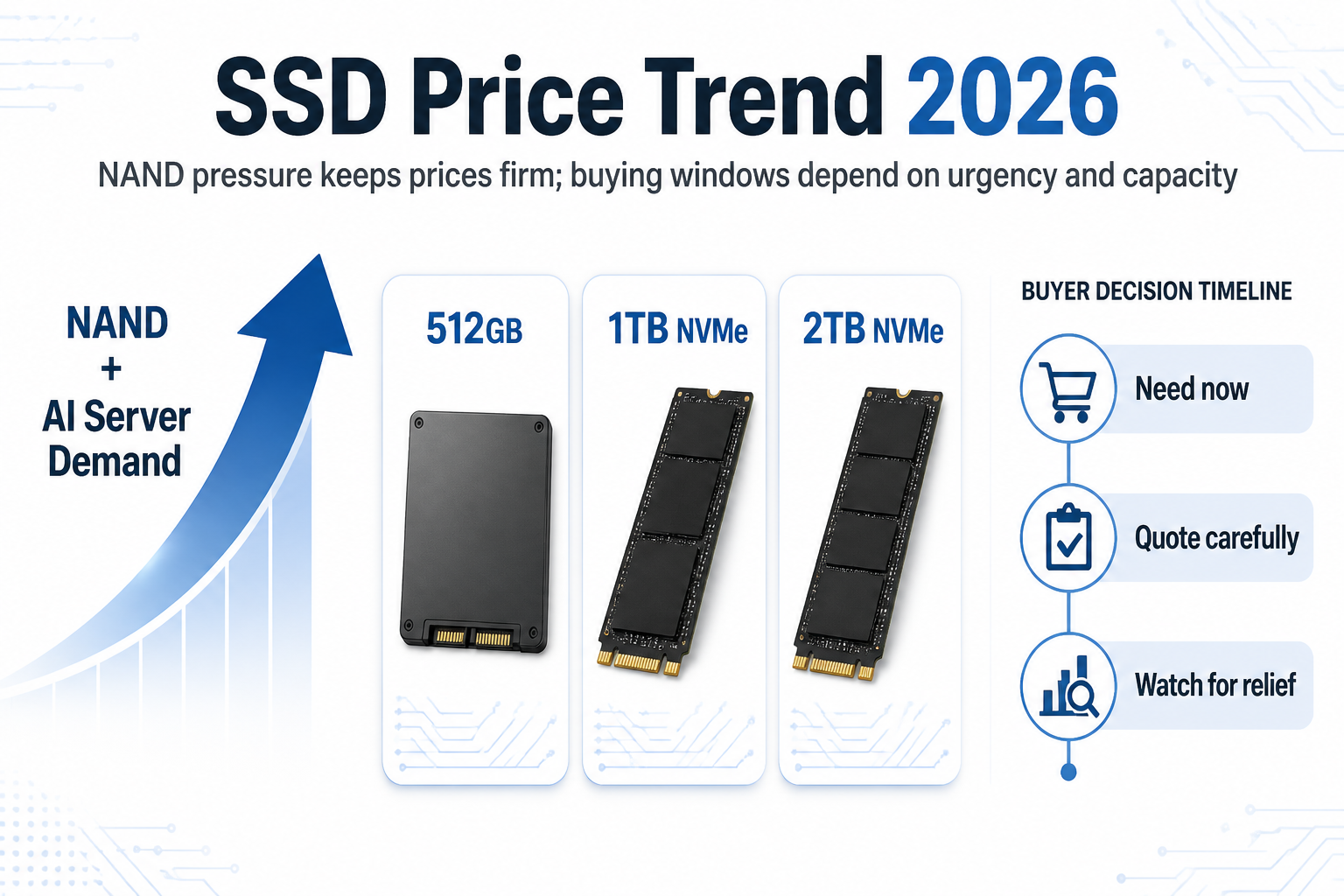
This page originally explained the SSD price trend in 2025. It still ranks for useful queries such as 1TB NVMe SSD price 2025, SSD price trend, and when will SSD prices drop. The better use of this page in 2026 is to connect what happened in 2025 with what buyers should expect now.
Quick Answer
- 2025 was the setup year: NAND supply discipline and demand recovery stopped SSD pricing from feeling like a simple decline.
- 2026 is firmer: TrendForce data points to stronger NAND contract-price pressure, especially as enterprise SSD demand absorbs supply.
- 1TB NVMe remains the key segment: it is the capacity most buyers watch when comparing mainstream SSD value.
- Do not treat 2025 prices as today’s quote: old retail lows may not represent 2026 replacement or volume-buying conditions.
2025 vs 2026 SSD Price Trend
| Question | 2025 Reading | 2026 Buyer Meaning |
|---|---|---|
| Did SSD prices keep falling? | Not in a straight line. Better demand and supply control made the market less loose. | Do not assume old discount levels will return automatically. |
| What mattered most? | NAND supply, consumer demand recovery, and capacity mix. | NAND contract pressure and enterprise SSD allocation matter more. |
| What should 1TB NVMe buyers do? | Use 2025 pricing as historical context. | Compare current quotes and warranty terms instead of waiting for a perfect low. |
Source note: TrendForce reported on March 31, 2026 that NAND Flash contract prices were projected to rise sharply in 2Q26 as AI server and data center demand pushed more NAND capacity toward enterprise SSDs. That is the market context behind this 2026 refresh.
How to Use This Page Now
If you came here asking whether SSD prices are dropping, the answer is more cautious than it looked in older 2025 forecasts. Some products will still go on promotion. But for 1TB and 2TB NVMe SSDs, 2026 buying decisions should be based on NAND pressure, real quote validity, and whether the system actually needs the upgrade now.
Original 2025 Context and Buying Notes
SSD prices in 2025 are generally higher than the low points seen in the previous cycle, especially for mainstream capacities such as 1TB NVMe SSDs. If your main question is “What is the SSD price trend in 2025?” the short answer is this: prices recovered from earlier lows, stayed firmer through much of the year, and buyers should not expect broad, deep discounts across every SSD category.
Table of Contents
- What Is the SSD Price Trend in 2025?
- Why SSD Prices Changed in 2025
- What Happened to 1TB NVMe SSD Prices in 2025?
- Consumer vs Industrial SSD Pricing in 2025
- Buying Advice for 2025
- FAQ
What Is the SSD Price Trend in 2025?
The 2025 SSD market is best described as a recovery-and-firming year rather than a discount year. Buyers searching for ssd price 2025, ssd price trend 2025, or 1tb nvme ssd price 2025 are usually trying to answer one practical question: should they buy now or wait for cheaper pricing? For most of 2025, the market did not reward aggressive waiting. Prices were no longer sitting at the unusually low levels seen in the previous down cycle.
That does not mean every SSD product rose at exactly the same pace. Entry-level SATA drives, mainstream NVMe models, and industrial SSDs each reacted differently depending on supply conditions and end-market demand. If you are comparing storage categories first, it helps to review the types of SSDs and SSD form factors before judging whether current pricing is reasonable.
Why SSD Prices Changed in 2025
The main factor behind SSD price movement in 2025 was NAND flash pricing. When memory manufacturers reduce output or keep supply disciplined after a period of oversupply, SSD prices stop falling and often move upward. That is a large part of what buyers saw in 2025.
Several other factors mattered as well:
- Supply discipline from major manufacturers: after previous oversupply, the market was less willing to push prices lower at any cost.
- Recovering demand: mainstream PC, commercial, and embedded demand improved enough to support firmer pricing.
- Enterprise and AI infrastructure demand: memory manufacturing priorities can influence how much capacity flows into the SSD market.
- Component mix: controller, DRAM, endurance target, and interface generation all affect the final selling price.
This is why broad statements like “SSDs are cheap now” or “all SSD prices are rising” are too simplistic. The more useful question is: which SSD segment are you buying, and for what type of use?
What Happened to 1TB NVMe SSD Prices in 2025?
Among all search intents, 1tb nvme ssd price 2025 is one of the clearest purchase-intent clusters. That makes sense. A 1TB NVMe SSD is the mainstream upgrade point for many desktops, laptops, workstations, and embedded systems that need a practical balance of cost and performance.
In 2025, 1TB NVMe SSD pricing generally sat above the most aggressive low-cycle deals buyers had seen before. Mainstream Gen4 NVMe drives remained attractive, but shoppers who expected the cheapest historical prices often found that the market had already moved on.
When evaluating 1TB NVMe pricing in 2025, buyers should separate three questions:
- Is the drive consumer or industrial? Industrial variants naturally price higher.
- What controller and NAND tier is being used? Budget and mainstream products are not equal.
- Is the purchase one-off or volume-based? Business sourcing decisions should be made differently from retail impulse buys.
| SSD Segment | 2025 Price Behavior | Typical Buyer Note |
|---|---|---|
| 500GB SATA SSD | Still relatively price-sensitive | Useful for budget upgrades and older systems. |
| 1TB NVMe SSD | Mainstream and closely watched | Best balance of capacity and performance for many buyers. |
| 2TB NVMe SSD | Can remain relatively firm | Larger capacities do not always soften as quickly as buyers expect. |
| Industrial SSD | Less discount-driven | Reliability, endurance, and lifecycle support preserve pricing. |
For users comparing speed and interface tradeoffs, Qootec’s NVMe Gen4 SSD line and 2.5″ SATA SSD options represent two very different purchase decisions, even when capacity looks similar on paper.
Consumer vs Industrial SSD Pricing in 2025
One of the biggest reasons buyers get confused about SSD pricing is that industrial storage is often discussed as if it were just a more expensive retail SSD. That is not how real sourcing works.
Consumer SSD pricing is shaped by retail competition, promotions, and mainstream capacity demand. Industrial SSD pricing is shaped by endurance targets, firmware validation, temperature range, BOM stability, and long-term availability. A low retail price does not help much if the drive is being installed in a kiosk, industrial PC, factory controller, or embedded deployment where replacement costs are far higher than the initial hardware savings.
This is why products such as Qootec’s industrial M.2 SSD and wide-temperature mSATA SSD are evaluated differently from consumer drives sold mainly for general-purpose PC upgrades. In industrial and commercial projects, consistent supply and stable specifications often matter more than chasing the lowest temporary market price.
Buyers sourcing for business use should also review how to choose the right SSD for your needs and SSD lifespan and endurance guidance before making purely price-based decisions.
Buying Advice for 2025
For individual buyers
- If you need a drive for an upgrade now, do not over-optimize for a perfect future discount that may not be meaningful.
- If your shortlist includes both SATA and NVMe, choose based on your system support and actual workload, not only on sticker price.
- Evaluate 1TB NVMe pricing as a mainstream value point instead of assuming cheaper always means better.
For business and project buyers
- Request quotes based on your actual capacity and lifecycle needs, not generic headline market pricing.
- Separate consumer market assumptions from industrial sourcing logic.
- Ask about BOM consistency, endurance, warranty behavior, and long-term availability before approving bulk orders.
- If timing is flexible, compare quotes over time, but do not delay production-critical deployments solely for a hoped-for price drop.
For B2B buyers, especially importers, integrators, and OEM customers, the right SSD decision is usually a balance of pricing, supply stability, and application fit. That matters far more than chasing the lowest short-term number in the market.
FAQ
What is the SSD price trend in 2025?
In general, SSD prices in 2025 are firmer than the unusually low prices seen in the prior down cycle. The market is better described as recovering and stabilizing upward than continuing to fall.
Will SSD prices drop in 2025?
Some individual products may become more competitive later in the year, but buyers should not assume a broad market-wide drop across all SSD categories.
What is the average 1TB NVMe SSD price in 2025?
The exact number depends on brand tier, controller, NAND type, and region, but the important trend is that 1TB NVMe pricing in 2025 remained above the deepest low-cycle deals many buyers remembered.
Why are industrial SSDs more expensive?
Industrial SSDs usually require wider operating tolerance, stronger endurance, validated firmware, BOM stability, and longer lifecycle support. Those factors make them less discount-driven than consumer storage.
Should I buy SATA or NVMe in 2025?
Choose NVMe when your platform supports it and performance matters. Choose SATA when compatibility, budget, or legacy system support matters more than peak throughput.

Shenzhen, China · Est. 2014
Qootec supplies consumer, commercial, and industrial SSD products for global buyers. If you need help evaluating SATA, NVMe, mSATA, or industrial storage for your project, contact our team.