


August 2026 Update: Where the Trend Stands Now
Updated August 5, 2026. Halfway through the year, the 2026 price story has two chapters. Contract prices surged more than 100% across the first half, with the steepest quarter-on-quarter jumps landing in Q2. Now the curve is bending: TrendForce projects NAND contract prices to rise a further 10–15% in Q3 — still up, but no longer runaway. SLC NAND remains the exception, climbing hard on networking and automotive demand against structural shortages. If you are timing a purchase, our updated take on when SSD prices will drop covers the buying windows. (Sources: TrendForce, June 2026; TrendForce, July 2026)
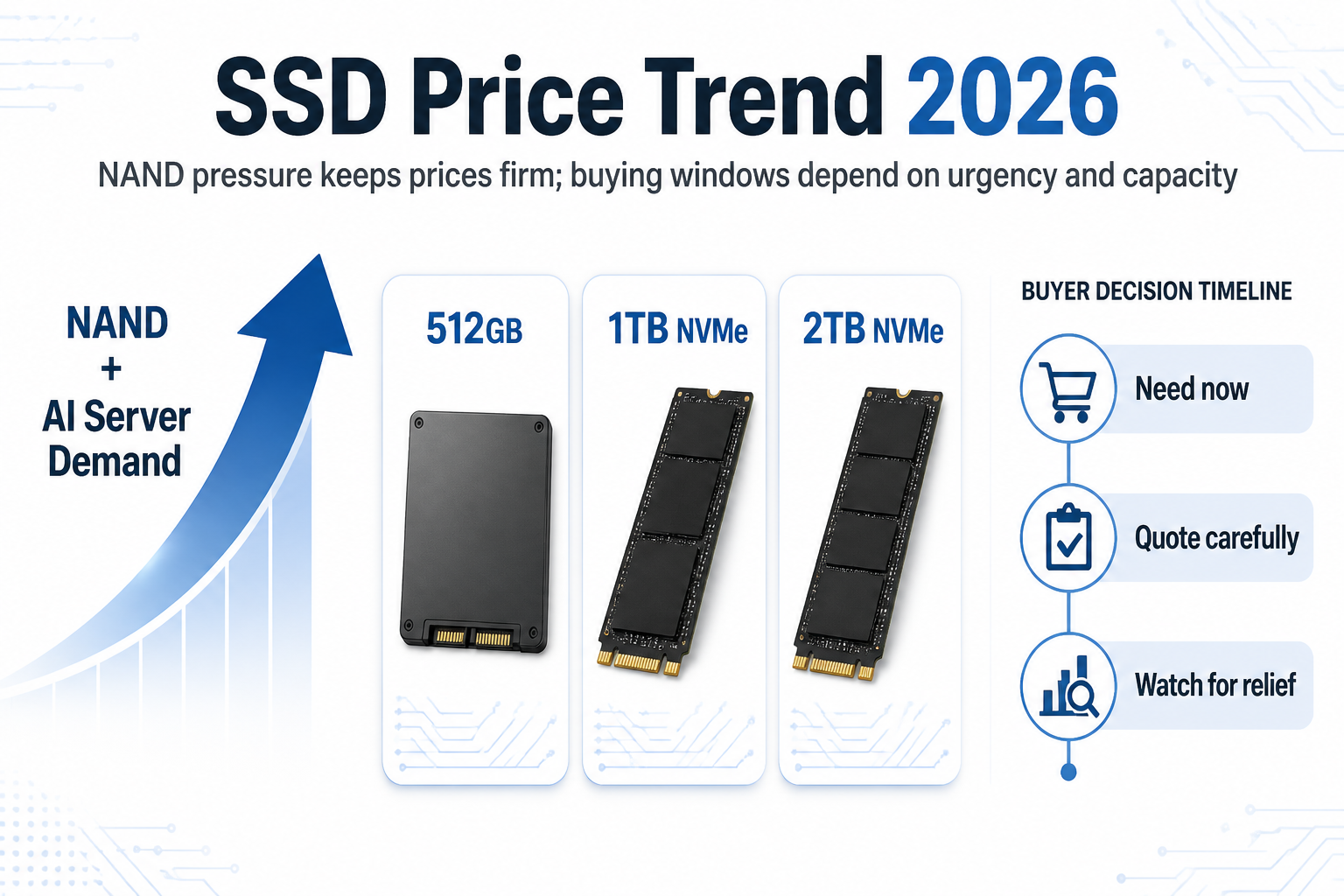
SSD prices in 2026 are not behaving like a normal discount cycle. If you are searching for 1TB NVMe SSD price 2026, 1TB NVMe SSD price April 2026, or SSD price trend 2026, the short answer is this: prices are under upward pressure, and buyers should not plan around a sudden crash.
The reason is NAND supply. TrendForce reported on March 31, 2026 that NAND Flash contract prices were projected to rise sharply in 2Q26, driven by AI server and data center demand. TrendForce also noted that NAND capacity is increasingly being allocated to enterprise SSDs, while consumer applications scale back under cost pressure. That matters for ordinary 1TB and 2TB NVMe buyers because consumer SSD pricing does not move in isolation.
So the practical answer is not “wait until SSDs get cheap.” The better answer is: buy urgent capacity now, quote carefully for volume purchases, and watch NAND signals before assuming late-2026 relief.
Quick Answer
- SSD prices are firm in 2026: NAND cost pressure and enterprise SSD demand are limiting easy discounts.
- 1TB NVMe is the main watch segment: it has the largest search demand and is usually the practical mainstream capacity.
- 2TB NVMe may stay less flexible: higher-capacity drives are more exposed to NAND cost and product-tier differences.
- Do not use one retail deal as the market: promotions can happen even when the supply-side trend is tight.
- Industrial SSD buyers should plan differently: BOM stability, validation, temperature range, and lifecycle supply matter more than short-term retail discounts.
Table of Contents
- Will SSD Prices Go Down in 2026?
- What April 2026 Data Says About SSD Prices
- 1TB NVMe SSD Price 2026: What Buyers Should Expect
- 2TB NVMe SSD Price 2026: Why It Can Stay Firm
- 512GB vs 1TB vs 2TB SSD Buying Timing
- Why SSD Prices Are Rising or Staying Firm
- Consumer SSD vs Industrial SSD Price Trends
- SSD Buying Strategy for 2026
- FAQ
Will SSD Prices Go Down in 2026?
Some individual SSD models may go on sale in 2026. That is normal. But the broader price trend is not pointing to a clean, market-wide drop. NAND Flash pricing, AI server demand, enterprise SSD allocation, and constrained supply are all making SSD prices harder to predict.
For a small buyer, this means you may still find a good retail deal. For an importer, system integrator, or industrial buyer, it means you should not build your procurement plan around a dramatic second-half price collapse.
The better working assumption is:
- urgent SSD purchases should be made around real need, not perfect timing;
- volume purchases should be quoted in stages instead of assumed from old price levels;
- 1TB NVMe and 2TB NVMe pricing should be watched separately;
- industrial SSD sourcing should prioritize supply stability and specification control.
What April 2026 Data Says About SSD Prices
By April 2026, the market signal had turned much stronger than a simple “maybe cheaper later” story.
TrendForce’s NAND Flash price page listed 1Q26 PC-client OEM SSD contract prices for value-grade PCIe TLC drives, including a 1TB mSATA/M.2 TLC PCIe value-grade average of 153.90 and a 512GB average of 97.10. These are contract-market snapshots, not universal online retail prices, but they are useful because they show the cost base that many downstream SSD quotes sit on top of.
The same TrendForce page also showed April 2026 SSD street-price examples with large year-over-year changes on several listed models. Again, individual model prices should not be treated as the whole market, but they reinforce the same point: buyers should not assume that 2026 SSD pricing is sliding smoothly downward.
| Signal | What It Means for SSD Buyers | How to Act |
|---|---|---|
| NAND contract pricing pressure | The base component cost behind SSDs is not relaxed. | Avoid assuming old quotes will remain valid for long. |
| AI server and enterprise SSD demand | Higher-value enterprise products can absorb NAND supply. | Watch lead times as carefully as unit price. |
| Consumer applications under cost pressure | Retail discounts may be selective rather than broad. | Buy by capacity need and platform fit, not only sale timing. |
1TB NVMe SSD Price 2026: What Buyers Should Expect
The 1TB NVMe SSD price 2026 query is important because 1TB is the mainstream capacity for many laptops, desktops, commercial systems, and embedded builds. It is large enough for real work, but still common enough to attract competition.
That does not mean 1TB NVMe drives will automatically become cheap. A 1TB NVMe SSD still depends on NAND package cost, controller cost, interface generation, DRAM or DRAM-less design, brand positioning, and channel inventory. A PCIe Gen4 value drive and a premium PCIe Gen5 drive can move very differently even when both are “1TB NVMe SSDs.”
For buyers, the most practical view is:
- if you need one drive for a working machine, buy when the product and warranty fit;
- if you are buying many drives, ask suppliers how long quotes are valid;
- if you can wait, monitor NAND and channel signals monthly rather than assuming a fixed low point;
- if the system supports NVMe, the performance value over SATA is often still worth considering.
If you are still comparing interfaces, Qootec’s guides to SSD types, SSD form factors, and M.2 SATA vs M.2 NVMe can help separate price from platform compatibility.
2TB NVMe SSD Price 2026: Why It Can Stay Firm
2TB NVMe SSDs are attractive because they give users more breathing room for games, media work, development environments, local AI tools, surveillance clips, and project files. But higher capacity also means more NAND content per drive. When NAND costs rise, 2TB models may not soften as quickly as buyers hope.
This is especially true when a 2TB SSD sits in a higher-performance product family. The price is not only the flash. It may also include a stronger controller, better thermal design, DRAM, firmware tuning, and a higher product margin.
For most 2026 buyers, the decision should be simple:
- choose 1TB if your priority is mainstream value;
- choose 2TB if replacing the drive later would be inconvenient or expensive;
- choose industrial or commercial-grade storage when the system is deployed, unattended, or difficult to service;
- avoid buying too small only because the current sticker price looks better.
512GB vs 1TB vs 2TB SSD Buying Timing
| Capacity Segment | 2026 Price Behavior | Best Buyer Fit | Timing Advice |
|---|---|---|---|
| 512GB SSD | May still see selective entry-level offers, but not immune to NAND pressure. | Basic upgrades, boot drives, fixed-function systems. | Buy if capacity is enough; do not over-optimize small savings. |
| 1TB NVMe SSD | Most competitive mainstream segment, but heavily watched and supply-sensitive. | Laptops, desktops, commercial systems, general-purpose upgrades. | Compare quotes carefully; buy when price, warranty, and platform fit align. |
| 2TB NVMe SSD | Can remain firmer because more NAND is built into every drive. | Content creation, gaming, engineering workstations, storage-heavy systems. | Buy if future replacement is costly; wait only if the project is flexible. |
| Industrial SSD | Less tied to retail promotions and more tied to validation, endurance, and lifecycle control. | Embedded, industrial PC, kiosk, POS, automation, and edge systems. | Prioritize stable supply and verified specifications over short-term discounts. |
Why SSD Prices Are Rising or Staying Firm
SSD prices rise or stay firm when the market has pressure at several layers at once. In 2026, the important layers are not hard to see.
NAND Flash cost
NAND is the core storage component inside SSDs. When NAND contract prices rise, SSD makers have less room to reduce finished-drive pricing. That does not mean every SSD price changes immediately, but it changes the cost environment.
Enterprise SSD allocation
Enterprise SSDs can be more attractive to suppliers when data center and AI infrastructure demand is strong. If more NAND is allocated to enterprise products, consumer and commercial segments may face less pricing relief.
Capacity and interface mix
512GB, 1TB, and 2TB models do not move identically. SATA, PCIe Gen3, Gen4, and Gen5 products also have different cost and margin structures. That is why “SSD prices” is too broad unless you specify capacity and interface.
Inventory timing
Retail pricing can lag component pricing. A store may discount old inventory even while new supplier quotes are rising. That can create confusing signals for buyers who compare one sale price with a broader market trend.
Consumer SSD vs Industrial SSD Price Trends
Consumer SSD prices are more likely to show visible promotions. Industrial SSD prices are usually steadier because the buyer is not paying only for flash. The buyer is also paying for qualification, controlled components, firmware consistency, endurance planning, temperature range, and long lifecycle support.
For example, a standard consumer NVMe SSD may be a good choice for a laptop upgrade. It is not automatically the right choice for a kiosk, factory PC, POS terminal, rail device, medical device, or outdoor edge gateway. In those systems, a drive failure can cost far more than the drive itself.
That is why Qootec separates consumer, commercial, and industrial SSD decisions. If your project needs consistent sourcing rather than the cheapest one-time retail deal, review what an industrial SSD is, wide-temperature SSDs, industrial M.2 SSDs, and wide-temperature mSATA SSDs.
SSD Buying Strategy for 2026
For individual buyers
- Buy now if your current drive is too small, failing, or blocking work.
- Choose 1TB NVMe for mainstream value when your system supports it.
- Choose 2TB when reinstalling or replacing later would be inconvenient.
- Do not wait months to save a small amount if the SSD solves a real bottleneck.
For B2B and industrial buyers
- Refresh quotes more frequently than usual in 2026.
- Ask how long pricing is valid and whether the BOM is stable.
- Separate consumer-grade price expectations from industrial-grade supply planning.
- Check endurance, operating temperature, PLP needs, firmware, and lifecycle support before locking volume orders.
- Consider phased purchasing if the rollout is large and timing is flexible.
If you are planning an industrial or embedded SSD project, the lowest short-term price is rarely the whole answer. The better question is whether the drive will remain available, compatible, and reliable across the life of the product.
FAQ
Will SSD prices drop in 2026?
Some models may go on sale, but the broader 2026 market is under NAND and enterprise-demand pressure. A market-wide price collapse is not a practical base case.
What is the 1TB NVMe SSD price trend in 2026?
1TB NVMe is the most important mainstream segment to watch. It can still be competitive, but pricing depends on NAND cost, controller tier, interface generation, and channel inventory.
Is April 2026 a good time to buy an SSD?
If you need the SSD now, yes, buy the right drive. If the purchase is flexible or high-volume, April 2026 data suggests you should quote carefully and watch NAND price pressure before assuming prices will fall soon.
Will 2TB NVMe SSD prices fall faster than 1TB prices?
Not necessarily. A 2TB SSD contains more NAND, so it can stay firm when NAND costs rise. Premium 2TB models may also hold price because of controller, thermal, and performance positioning.
Why are industrial SSDs more expensive than consumer SSDs?
Industrial SSDs usually include stricter validation, wider operating-temperature options, stable BOM control, endurance-focused design, and longer lifecycle support. Those factors make pricing less promotional than consumer SSD pricing.
Should I wait for lower SSD prices or buy now?
Buy now if the SSD solves an urgent capacity, reliability, or deployment problem. Wait only if the project is flexible and you can monitor quotes without risking delays.

Shenzhen, China · Est. 2014
Qootec develops consumer, commercial, and industrial SSD solutions for global buyers. If you need help selecting SATA, NVMe, mSATA, or wide-temperature SSDs for your application, contact our team.